
There is a conversation I’m having more and more with employers at the moment, and it normally starts with recruitment…….
“We’re just not getting the right people applying.”
“The candidates we want aren’t interested.”
“We’ve advertised it three times and still haven’t found anyone.”
And I completely understand the frustration. When you have a vacancy that is holding the business back, your immediate reaction is naturally to look at the recruitment process.
Is the salary competitive?
Are we advertising in the right places?
Do we need to use a recruiter?
All completely valid questions.
But after nearly 20 years working in recruitment, I’ve learnt that sometimes the recruitment problem starts much earlier than that.
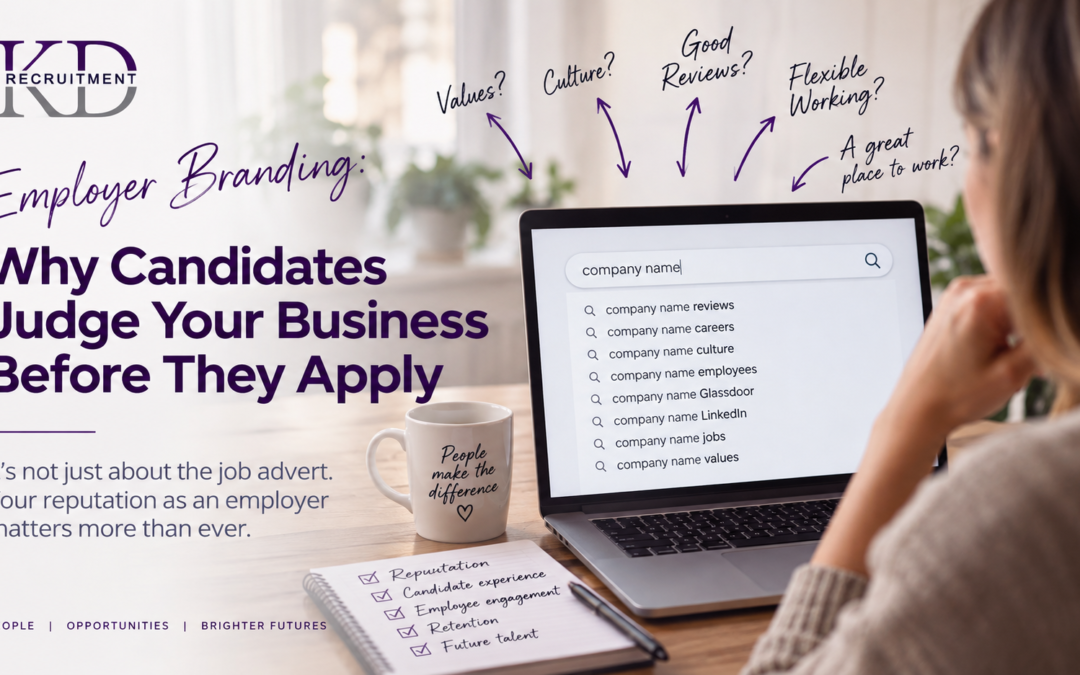
Because before someone applies for your job, there’s a very good chance they’ve already looked you up.
And what they find forms part of your employer brand.
What is employer branding?
Employer branding is the reputation your organisation has as a place to work.
It is shaped by what current employees say about you, how your leaders behave, your culture, flexibility, development opportunities, candidate experience, values and how your organisation presents itself online.
In simple terms, it is this: What do people believe it is actually like to work for your business?
That perception can have a major impact on whether someone applies for a job, accepts an offer or stays with your organisation long term.
And whether you have intentionally built an employer brand or not, you already have one. Candidates are researching employers before they apply
We all do it now, don’t we?
Before I book a restaurant, I’ll probably look at the reviews. If I’m booking a hotel, I want to see what other people have said about it. If I’m buying something expensive, I’m going to do a bit of research first.
So why would we expect somebody making a potentially life-changing career decision to behave any differently?
Candidates might visit your website, then your LinkedIn page, they may look at the profiles of the people who work there, they could check Glassdoor, Google reviews or social media, they might even ask somebody they know who already works for you. More recently, more and more people are looking into businesses through an AI lense as well.
And all of that can happen before they have even decided whether to apply. Which means your recruitment process is starting long before the job advert goes live.
Your employer brand isn’t just your careers page
This is one of the biggest misconceptions around employer branding. It isn’t a shiny careers page, professional photographs or a few social media posts showing people having lunch together. Those things can support your employer brand, but they don’t create it.
Your employer brand is what people experience.
- It is what your employees say about the company when you’re not in the room.
- It is how your managers lead.
- It is whether people are supported to develop.
- It is whether your values actually influence decisions.
- It is how people are treated when things go wrong, not just when everything is going well.
You can spend a huge amount of money presenting your business in a certain way, but if the reality doesn’t match, candidates will eventually find out.
And today, they can find out very quickly.
What is an Employee Value Proposition, or EVP?
Your Employee Value Proposition, or EVP, is what employees receive in return for the skills, experience and contribution they bring to your organisation.
Put more simply……. Why should somebody choose to work for you rather than another employer offering a similar role?
Salary obviously matters. But your EVP is much bigger than salary.
It can include:
- Flexible working
- Training and development
- Career progression
- Leadership and management
- Reward and Recognition
- Benefits (financial and non-financial)
- Job security
- Workplace culture
- Purpose and values
- Autonomy and trust
- Wellbeing
- Relationships with colleagues
And the important bit? It has to be genuine.
There is no point advertising flexibility if employees feel guilty for using it.
There is no point talking about career development if nobody can give an example of someone who has actually progressed.
And there is very little value in having company values displayed everywhere if employees don’t experience them in the way the business operates.
Your employer brand isn’t what you tell people it is. It is what they experience.
Why do your best employees stay?
This is a question I think more employers should ask.
If you have good people who have stayed with your organisation for years, find out why.
What do they value?
What keeps them there?
What could make them leave?
What do they tell other people about the business?
Sometimes the most useful insight into your employer brand is already sitting inside your organisation.
Your current employees understand your culture in a way that no external marketing agency ever could. And they will usually tell you very clearly what is working and what isn’t.
Flexibility is part of employer branding, but it doesn’t always mean working from home.
This is particularly relevant to businesses across North and East Yorkshire.
Many of the employers we work with operate in manufacturing, engineering, hospitality and other sectors where people physically need to be in the workplace. You can’t manufacture something from the kitchen table.
So flexibility does not automatically have to mean hybrid working. It could mean different start and finish times, compressed hours, part-time working, some flexibility around family commitments, or simply creating a culture where someone can speak honestly to their manager when life happens.
Different businesses can offer different things.
What matters is understanding what you can genuinely offer and communicating it honestly.
Because promising flexibility during recruitment and then making somebody feel uncomfortable for using it can damage trust very quickly.
Leadership has become part of your employer brand
Candidates don’t just research businesses anymore. They research the people running them too.
They can look at your Managing Director on LinkedIn, look at who your senior team are, review whether your leaders talk about their people, their industry, the local community and what actually seems to matter to them.
That visibility tells people something about the organisation.
For SMEs in particular, this can make a real difference as job seekers aren’t only choosing a company. They are choosing the people they are going to spend a huge part of their week working with, and often, working for.
Candidate experience is part of employer branding
You can be a great employer and still give somebody a terrible recruitment experience.
We’ve probably all heard examples……
Someone applies for a job and hears nothing.
They attend an interview and then wait weeks for feedback.
They are told there will be two interview stages, and suddenly there are four.
Or they accept the job, hand their notice in and barely hear anything from their new employer until their first day.
Put yourself in their shoes., what would you be thinking?
That experience is already telling them something about what it might be like to work for you.
If communication during recruitment is slow and disorganised, they may wonder whether communication inside the business will be the same.
If nobody appears to value their time during the interview process, they may wonder whether their time will be valued once they are employed.
That assumption may not always be fair. But people form opinions based on the information they have.
And that is why candidate experience and employer branding are so closely connected, it includes the people you don’t employ too.
I’ve always believed that how you reject somebody matters as much as contacting successful candidates too.
Today’s unsuccessful candidate could be tomorrow’s perfect employee. They could also be a future customer, supplier or someone who talks about their experience with your business.
Remember that people remember how you make them feel.
Your employees are one of your best employer branding tools
If you really want candidates to understand what your organisation is like, let them hear from the people already working there.
Not scripted corporate testimonials – Real stories.
Someone who joined as an apprentice and is now managing a team, an employee who has been with you for 15 years, someone you supported through a professional qualification, a person who changed careers and was given an opportunity when another employer wouldn’t take the chance.
Those stories tell candidates far more about your organisation than a list of benefits ever could.
And they don’t need to be perfectly produced. Sometimes the less polished content is the content people trust most, because it feels real.
Don’t only talk about your business when you’re recruiting
This is one of the biggest employer branding mistakes I see.
A vacancy appears and suddenly the business comes alive online.
“We’re hiring!”
“Come and join our fantastic team!”
Then the vacancy is filled and everything goes quiet again, until the next person leaves.
But imagine doing things differently.
Imagine someone following your organisation for six months and seeing employees progressing, people completing qualifications, teams celebrating success, community involvement, apprentices joining the business and employees talking openly about their careers.
Then a vacancy appears.
They already know who you are.
They already have a sense of your culture.
They may even have thought: “I’d quite like to work there one day.”
That is a completely different starting point to someone seeing your business for the first time on a job board. And it is why I believe recruitment needs to become more proactive.
Talent attraction shouldn’t start when somebody resigns.
How does employer branding affect recruitment and retention?
Employer branding can influence both whether people join your organisation and whether they stay.
A strong employer brand can help people understand what your organisation stands for, what working there feels like and whether it fits what they are looking for.
But there is an important warning here. If the experience after somebody joins bears no resemblance to what was promised during recruitment, employer branding can actually work against you.
If people join expecting development, flexibility or a certain culture and don’t experience it, they may leave. And when they leave, they may tell others, which takes you straight back to where we started.
Your employer brand is what people believe it is like to work for you.
Recruitment problems can sometimes be a symptom of something bigger
This is why, when a business tells me they are struggling to recruit, I don’t just want to know about the vacancy anymore.
- I want to understand what is happening around it.
- Why did the previous person leave?
- How long do people usually stay?
- What does onboarding look like?
- Are salaries still competitive?
- What development opportunities exist?
- What do employees say about working there?
- How are managers managing?
- What does your candidate experience look like?
Because sometimes you don’t have an advertising problem. You don’t even necessarily have a recruitment problem. You may have a retention, leadership, EVP or reputation problem that is showing itself through recruitment.
And another job advert won’t fix that.
How can you improve your employer brand?
Before you advertise your next vacancy, try looking at your organisation through the eyes of somebody who knows absolutely nothing about it.
Google your company, ask AI about market leaders in your industry, look at your website, read your reviews, scroll through your social media, look at your leadership team’s LinkedIn profiles, read your latest job adverts, think about your application and interview process.
And then ask your employees a simple question: “If one of your friends was thinking about working here, what would you tell them?”
I’d be genuinely interested in the answer. Because that answer is probably much closer to your true employer brand than anything written in a marketing document.
Why employer branding matters in recruitment
Recruitment has changed enormously during my career, but one thing hasn’t.
People want to work somewhere they feel valued, where they can do good work and where the organisation fits what matters to them.
The difference now is that candidates have far more ways of finding out whether your business offers that before they ever apply.
So perhaps the question isn’t just: “How do we get more people to apply for our jobs?”
Maybe the better question is: “Are we building a business that the people we want to employ actually want to join?”
Because if the answer to that is yes, attracting and retaining the right people becomes a whole lot easier.
At KD Recruitment, we work with businesses across North and East Yorkshire to look at recruitment in the wider context of attraction, retention, employer branding, EVP and workforce planning.
Because successful recruitment shouldn’t start when somebody hands in their notice.